For interventional psychiatry clinics & networks
Detect relapse early.
Unlock the next reimbursable course.
Patient churn is the single largest leak in interventional psychiatry. ~80% of Spravato patients discontinue inside 12 months. ~50% of TMS responders relapse, and most never come back. Emobot is the passive between-visit signal that catches the drift early, nudges the patient back, and converts silent churn into a returning patient — a new reimbursable course on the commercial side, a sooner and more frequent return on the self-pay side.
24%
TMS patients don't complete the acute course (Sackeim 2020 · NeuroStar Registry)[24]
37.5%
of TMS responders relapse within 12 months (Dunner 2014)[11]
79.6%
of Spravato patients discontinue inside 12 months (ESKALE)[26]
48h
Emobot early-warning lead time on relapse signal (internal cohort analysis)[15]
The problem
Between visits, the clinic goes dark.
IP treatment works. The published outcomes for TMS, Spravato and ketamine are real. The leak is between visits — and current workflow has no tool that captures what happens there.
34.8%
Mean dropout from outpatient mental health care; 70%+ happens after the first or second visit.[17]
19–50%
No-show rate range across outpatient psychiatric clinics.[16]
Each of these is a different shape of the same gap: no continuous, low-burden signal between a TMS session, a Spravato dose, or a psychiatry follow-up. Patients drift, no-show, and silently relapse — and the clinic only learns about it when the schedule has a hole in it.
The Emobot vision
The continuous signal between visits: captured passively, owned by the patient, shared at the clinic’s request.
Psychiatry has tracked severe illness with self-report scales every 4–6 weeks[2],[3]. Emobot is the passive, multimodal layer that fills the gap — and only the numerical trend ever reaches the dashboard, when the patient opts in.[15]
Core property
Passive
3-min install, then nothing. No surveys, no check-ins.
Core property
Multimodal
Facial + voice + actigraphy + app usage. Four channels, one score.
Core property
Continuous
Every day between visits. Not a snapshot every 4 weeks.
How Emobot stops the leak
Two paths to the same outcome: a returning patient.
Emobot stops churn through two complementary mechanisms — same product, different revenue paths depending on whether your clinic bills a payer or is paid out-of-pocket.
Detect the relapse, unlock the next course.
Every silent relapse should have triggered a maintenance TMS course or a Spravato booster the payer would have funded.
The Emobot loop
- 01Passive signal detects deterioration 48h before clinical signs
- 02Patient is nudged inside their own app — not chased by your staff
- 03Patient rebooks directly through the app
- 04You deliver the next reimbursable course; payer funds it
Per recaptured patient
+$6–11k
Funded by
The payer
Empower the patient. They’ll come back sooner, more often.
Patients see their own mood trend for the first time. That awareness brings them back — sooner, and more often than the schedule alone would.
The Emobot loop
- 01Patient sees their own continuous mood trend on their phone
- 02Awareness + objectification of mental state
- 03When the trend dips, the app nudges them to check in
- 04Patient returns to the clinic earlier, and more often
LTV uplift
4–7×
Funded by
Sooner & more frequent visits
Same product, two paths. Both end the same way: a patient back in your clinic, in time for the treatment they needed.
Live simulation
Try the math yourself before we tell you ours.
Pick a clinic model, set new patients per year, and press play. The relapse curve is anchored to published data (30% by month 3, 50% by month 12, 70% by month 24). The yellow moments are where Emobot flags a drift before the patient drops off — its subscription cost already netted out.
Clinic model
TMS maintenance · Spravato continuation · payer-funded
Month 0 / 24 mo
Each recaptured relapse = a reimbursable booster course (~$9k). Without early warning, 60% are silent. Year-2 onboards a new cohort on top of the first.
Month 0 · 100 active patients in maintenance. Baseline monthly revenue begins. Today the clinic has no signal between visits.
Today's workflow — silent churn
Without Emobot
Year-1 cohort · joined M0
Year-2 cohort · joins at M12
In care
50/50
Lost
0
Silent loss
0
Cumulative revenue · 12-month
$13k
Continuous signal + early-intervention rebook
With Emobot
Year-1 cohort · joined M0
Year-2 cohort · joins at M12
In care
50/50
Lost
0
Saved by Emobot
0
Cumulative revenue · 12-month
$13k
Revenue uplift · Emobot vs. no-Emobot · Month 0
+0%
That’s $0 of net additional revenue at today’s tick, after subscription costs are netted out. By year 2, the gap compounds.
Patients saved vs. baseline (year-end)
+23
Final 24-month absolute delta
$214k
Drift and recapture rates are anchored to the same literature cited in the business and outcomes sections below (Dunner 2014[11], SAINT PCT[7], maintenance TMS systematic review[9], 2026 Ketamine Clinic Intelligence Report[12]). The model is deterministic: the same cohort size reproduces the same outcome, so you can compare scenarios fairly.
Clinical workflow
How Emobot fits into your clinic week.
Zero new processes.
Emobot doesn’t add tasks to your staff. It removes the uncertainty — between TMS sessions, between Spravato doses, between psychiatry follow-ups.
After TMS session 1 or first Spravato dose
Enroll the patient in Emobot
You send a link. The patient sets up the wellness app in 3 minutes on their phone. After that, it runs in the background.
Ongoing; passive, on-device
The AI tracks mood, voice, activity and sleep
Continuous multimodal signal. Zero effort from the patient, zero task for your staff.
When early signs of deterioration appear
The patient is nudged inside their own app
48 hours before clinical signs of relapse, the app surfaces a gentle in-app reminder: “Your wellness score dipped this week. Want to book a follow-up with Dr. X?”
Same week
The patient rebooks directly from the app
They walk back into your clinic before they silently drop off; the relapse is recaptured at the earliest possible moment.
At the next visit
You deliver the right next course of care
Maintenance TMS, a Spravato booster, a new acute course, or medication adjustment: the clinical decision is yours. Emobot simply brought the patient back in time for you to make it.
What you actually see
Your clinician dashboard.
Open a browser. See every patient who’s opted in, ranked by wellness trend. The patients drifting toward relapse are surfaced first — so the rebooking conversation starts before the no-show does.
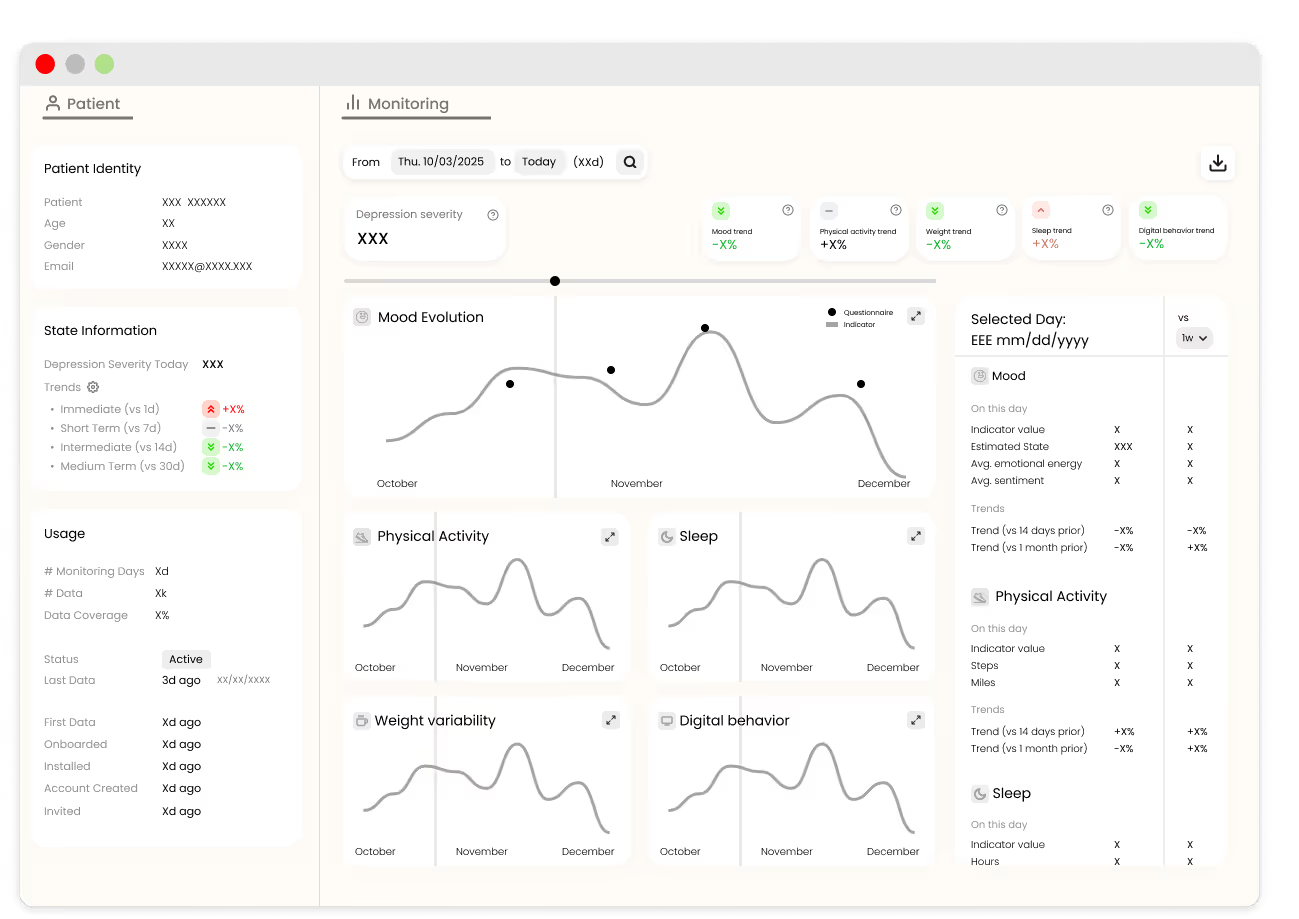
portal.emobothealth.com · No EHR integration · Patient data stays on the patient’s phone; you see only the trend they choose to share.
The care opportunity
The clinical upside is not about more data.
It’s about empowered patients, earlier decisions, and a stickier care relationship.
When the between-visit signal is continuous, three things change — patients engage, relapse is caught while intervention still works, and their history lives in your app. The evidence on all three is unambiguous.
Care pillar 01 · Empowerment
The patient becomes the master of their own mental health.
For the first time, patients see an objective trend of their own mood — passively captured, theirs to share. RCT data links self-monitoring with feedback to better self-awareness, adherence, outcomes, and satisfaction.[4],[5],[6]
Self-awareness[4]
Patients recognize drift days before they could articulate it.
Active role in care[5]
A trend to discuss at visits, not a symptom score to recall.
Justification to continue[6]
For self-pay patients: concrete evidence the treatment is working.
No daily burden[15]
Passive. 3-min install, then nothing. No streaks, no surveys.
 EmoDTx
Your wellness today
76
/100 · Feeling good
Today's signals
Mood
Facial
Voice
Vocal
Activity
Motion
Steps — 14 days
9,400 todayAll analysis on-device · Zero data transmitted
3-min setup
then passive
Monitoring active
The patient sees their own trend. The clinic sees it only when the patient chooses to share.
48h
Early-warning lead time before classical clinical signs of relapse[15]
0 bytes
Raw video or images ever stored long-term[15]
24 / 7
Passive signal capture — no patient action required[15]
Care pillar 02 · Outcomes
Whatever TMS protocol you run,
the outcomes literature is already yours.
Whatever protocol you run — NeuroStar, Magventure, Brainsway, accelerated, or Stanford SAINT — the finding is the same: catching the between-visit signal early beats catching it afterrelapse. Emobot is the continuous layer that makes “early” possible.[7],[8],[9]
SAINT PCT trial · Stanford · FDA-cleared protocol
Remission sustained at 12 months, with vs without early-intervention boosters
Relative uplift
+2.6×
Source: Stanford Health Care / SAINT PCT data. When early symptom return triggered a 1–2 day booster, 86% of patients remained in remission for the full year. That is more than double the rate of patients who received no maintenance after the acute course.
Meta-analysis · maintenance rTMS protocols
Catching the signal early doesn’t just help. It changes the trajectory
Response at 3 months
Without maintenance · 61.1%
With maintenance · 76.2%
Relapse by 20 weeks
Without maintenance · 81.8%
With maintenance · 37.8%
Source: Maintenance TMS protocols systematic review (PMC 2023) + MAINT-R RCT.
Care pillar 03 · Stickiness
When a patient monitors their own mood inside your clinic’s app, your clinic becomes their mental-health home.
Over weeks and months, your app becomes where the patient’s mental health lives. Leaving for another provider means losing their own history — and the retention data is unambiguous on what that does to loyalty.[20],[23]
80%
of digitally-engaged patients stay loyal
Their own mood history is a switching cost — research calls it loyalty-deepening.[20]
90%
completion at 4 months with personalised feedback
mHealth apps with personalised trend data hit this rate — how Emobot becomes a habit, not a tool patients forget.[23]
5×
more frequent clinic-app interactions
An on-demand tool tied to their provider makes your clinic the patient’s first call, not their second.[20]
The stickiness flywheel
01
Patient installs once
3 minutes. The app runs passively. They start to see their own mood trend.
02
Self-awareness grows
They recognise patterns. They understand the treatment is working, or that they need a rebook.
03
Clinic is the anchor
All their mental-health data lives here. Leaving means losing the trend.
04
Churn drops. Referrals rise.
They stay. They recommend. The clinic becomes their primary mental-health relationship.
The result: a 50% silent-churn baseline drops to 15–25% with Emobot — because the patient never fully disengages.[20],[23],[4]
In their own words
The clinical leaders deploying Emobot.
The IP physicians and network executives who run the clinics where Emobot is live — what they say about the data layer they were missing.
“Precision medicine requires real-time data to be effective. Emobot’s 100% passive, multimodal AI provides us with a continuous stream of objective biomarkers: effectively a ‘360-degree view’ of a patient’s emotional state. We believe this is the new gold standard for care; in fact, we expect every patient to be on Emobot.”
Dr. Jonathan Javitt, MD, MPH
Founder & CEO · Hope Therapeutics

“Emobot captures a really critical moment in someone’s illness — the moment when patients fall through the cracks. As psychiatrists, this is where we can interrupt the trajectory of deteriorating illness and do something about it. Patients with depression and anxiety have so little awareness of themselves; they forget when they felt good. Emobot lets them look back and correlate — that is amazing.”

Dr. Rebecca Cohen, MD
Chief Medical Officer · Hope Therapeutics
“Emobot has become a key asset for us. Our entire staff is behind it and we’re actively bringing peer IP clinics into the platform. This is the data layer interventional psychiatry has been missing.”

Dr. Carlene MacMillan, MD, FCTMSS
Co-founder · Radial Health & Emobot Medical Advisor

Want to hear it firsthand?
Talk to a reference customer.
We can introduce you to the clinical lead at one of our IP partners — Hope Therapeutics, Radial Health, or a single-site practice — for a 30-minute call about deployment, outcomes, and the patient-churn recovery they’ve actually seen.
Clinics deploying Emobot
From single-site TMS programs to national IP networks.
Emobot is live in US interventional psychiatry clinics, from independent TMS practices to large multi-site networks and research partnerships.



Hope Therapeutics press release → · Radial Health case study →
Pricing & terms
Simple, per-patient, tiered with scale.
Usage-based SaaS billed on Active Patient-Months. No setup fee. Month-to-month for solo clinics; annual MSAs available for networks.
1–50 patients
$49/active patient · month
Solo clinic, getting started
51–150 patients
$39/active patient · month
Established IP practice
151+ patients
$29/active patient · month
High-volume practice
For groups & networks
Running multiple sites? Let’s build your number.
Networks get a single agreement with a flat-fee rate and licences you can move between sites — scoped to how you actually operate.
- One MSA
- Flat-fee rate
- Transferable licences
Setup fee
None
Contract length
Monthly · annual MSA optional
Active patient
Patient enrolled & sharing data
Onboarding
30-min team training · first patient enrolled day 1
The subscription pays for itself on the first rebooked patient. See worked examples below, or open the ROI calculator to model your own clinic or network.
Security & compliance
Built for the standards your IT and Risk teams will ask about.
Emobot is a HIPAA Business Associate to your clinic, with the BAA built into our Terms (Exhibit A) and a parallel UK/EU DPA. Privacy is on-device by default — AWS HDS-class hosting, TLS 1.3 in transit, AES-256 at rest, and the clinic only ever sees a number, never a recording.
Common questions from clinics
We’ve heard every objection.
The questions a single owner-operator asks and the questions a network CMO asks overlap more than you’d think. Here are the most common ones, answered.
“We already use PHQ-9.”
PHQ-9 by email gets 30–40% completion and only captures one point in time. Emobot is continuous, passive, and objective. It captures the signal between your PHQ-9 assessments: the part you are currently flying blind on, and the part that actually drives rebooking.
“Our patients are tech-averse.”
80% of patients activate when a clinician proposes the app and installs it with them during the visit. The setup is 3 minutes: no account creation, no daily check-ins, no surveys. It runs in the background. Most patients forget it is even there until the app surfaces a check-in suggestion.
“We don't have staff bandwidth to manage another tool.”
Emobot requires zero ongoing staff time. The patient receives the nudge inside their own app and rebooks directly; your team simply sees the appointment land on the calendar. No alerts to triage, no dashboard to babysit, no outbound calls to make.
“Is this a remote monitoring device?”
No. Emobot is a patient-facing wellness app. The score, trend and nudges live inside the patient's own app. Patients optionally share their trend with you at visits; you never passively surveil them. That is why it can be used today, without a device-class gate.
“How does this integrate with our EHR?”
No EHR integration required. Clinicians access an optional standalone web dashboard at portal.emobothealth.com for patients who choose to share. Patient data stays separate from your EHR to keep compliance simple. Nothing to install on your side.
“What's the reimbursement model?”
Usage-based SaaS billed on Active Patient-Months across 3 tiers ($49 / $39 / $29 per patient-month, depending on cohort size). The economics are simple: each recaptured patient is worth $6k–$11k in retained revenue depending on payer model (a maintenance TMS course, a Spravato booster, or self-pay maintenance LTV). The subscription pays for itself on the first rebooked visit.
“Does this work the same way at network scale?”
Yes. A multi-site network runs Emobot at a single $30/patient-month tier across the entire network, but captures value through two distinct P&L pathways at the site level — LTV extension on self-pay clinics, reimbursed maintenance throughput on commercial clinics. One SaaS line item; revenue lift in two places.
Bring the math to your clinic — or your network.
We’ll model your self-pay and reimbursed clinics side-by-side and walk the P&L with you in 30 minutes. Same conversation works for one site or twenty.
Or self-serve at portal.emobothealth.com/signup
Sources & references
Every number on this page is cited.
- [1]Cole C et al. A systematic review on passive sensing for the prediction of suicidal thoughts and behaviors. npj Mental Health Research. 2024. https://www.nature.com/articles/s44184-024-00089-4
- [2]Moshe I et al. From smartphone data to clinically relevant predictions: A systematic review of digital phenotyping methods in depression. Neuroscience & Biobehavioral Reviews. 2024. https://www.sciencedirect.com/science/article/pii/S0149763424000095
- [3]Digital phenotyping for monitoring mental disorders: systematic review. Journal of Medical Internet Research. 2023. https://www.jmir.org/2023/1/e46778
- [4]Kramer I et al. Effects of momentary self-monitoring on empowerment in a randomized controlled trial in patients with depression. World Psychiatry. https://www.researchgate.net/publication/282641462_Effects_of_momentary_self-monitoring_on_empowerment_in_a_randomized_controlled_trial_in_patients_with_depression
- [5]Exploring Patient Empowerment in Major Depressive Disorder: Correlations of Trust, Active Role in Shared Decision-Making, and Symptomatology. PMC. 2024. https://pmc.ncbi.nlm.nih.gov/articles/PMC11508731/
- [6]Van Zoonen K et al. The use and helpfulness of self-management strategies for depression: The experiences of patients. PLOS One. https://journals.plos.org/plosone/article?id=10.1371/journal.pone.0206262
- [7]Cole SP et al. Stanford Accelerated Intelligent Neuromodulation Therapy (SAINT) — Personalized Continuation Trial: 86% remission sustained at 12 months with early-intervention boosters vs 33% without maintenance. Stanford Health Care. https://stanfordhealthcare.org/medical-treatments/s/stanford-accelerated-intelligent-neuromodulation-therapy.html
- [8]Durability of clinical benefit with Stanford Neuromodulation Therapy (SNT) in treatment-resistant depression. Brain Stimulation. 2025. https://www.sciencedirect.com/science/article/pii/S1935861X25000877
- [9]Investigating the Role of Maintenance TMS Protocols for Major Depression: Systematic Review. PMC. 2023. (Response at 3 mo: 76.2% with maintenance vs 61.1% without; relapse at 20 wk: 37.8% vs 81.8%.) https://pmc.ncbi.nlm.nih.gov/articles/PMC10141590/
- [10]MAINT-R Randomized Clinical Trial: Repetitive Transcranial Magnetic Stimulation as Maintenance Treatment of Depression. JAMA Network Open. https://jamanetwork.com/journals/jamanetworkopen/fullarticle/2835319
- [11]Dunner DL et al. A multisite, naturalistic, observational study of transcranial magnetic stimulation for patients with pharmacoresistant major depressive disorder: durability of benefit over a 1-year follow-up period. J Clin Psychiatry. 2014. https://pubmed.ncbi.nlm.nih.gov/25271871/
- [12]2026 Ketamine Clinic Intelligence Report: Induction patient LTV ~$2,100 vs 3-yr maintenance LTV $9,300–$14,700. HealingMaps. https://healingmaps.com/2026-ketamine-clinic-intelligence-report/
- [13]Ketamine Therapy Cost in 2026 — side-by-side provider comparison. Discreet Ketamine. https://discreetketamine.com/blog/ketamine-therapy-cost-comparison-2026
- [14]Private Practice vs Insurance-Based Practice — payment options and patient acquisition economics. TMS StartItUp. https://www.tmsstartitup.com/private-practice-vs-insurance-based-practice-can-i-take-insurance-and-private-pay
- [15]Emobot clinical validation: MADRS r=0.89, PHQ-9 r=0.83 across 10+ studies (Yale, Harvard, Johns Hopkins, UCSD, McGill, Charité Berlin, GHU Paris). Internal cohort analysis on 48-hour relapse-signal lead time and 4.3× net ROI; full methodology, n, and CIs available on request under NDA. https://emobothealth.com/clinical-evidence
- [16]No-show rates in outpatient psychiatric clinics range 19–50%. When wait times are reduced from 13 to 0 days, no-shows drop from 52%→18%. Psychiatric Services / American Psychiatric Association. https://psychiatryonline.org/doi/10.1176/appi.ps.201800161
- [17]Dropout from Outpatient Mental Health Care in the United States — mean 34.8% (range 10.3–81.0%); 70%+ of all dropout occurs after the first or second visit. Wang et al., PMC. https://pmc.ncbi.nlm.nih.gov/articles/PMC2774713/
- [18]Psychiatrists spend 10.6 hours/week (20.3% of working time) on administrative tasks — almost 3 hours more than the average physician. Administrative Friction and Clinician Burnout. https://pimsyehr.com/administrative-friction-and-clinician-burnout/
- [19]Prevalence and prediction of dropout during depression treatment in routine outpatient care — 32.7% of depression patients stopped treatment within 1 month. European Archives of Psychiatry & Clinical Neuroscience. https://link.springer.com/article/10.1007/s00406-022-01499-1
- [20]Patient digital engagement & retention — nearly 80% of digitally-engaged patients stay loyal to their provider; longitudinal digital health records represent a significant switching cost. Athenahealth digital engagement research 2025. https://www.athenahealth.com/resources/blog/patient-digital-engagement-research-2025
- [21]TMS clinic owner-operator challenges — the almost-daily nature of TMS treatment is a major obstacle to access; TMS clinics are operationally distinct from general psychiatric practice. TMS StartItUp consulting. https://www.tmsstartitup.com/tms-therapy-avoid-costly-mistakes
- [22]Inside the physician burnout crisis — administrative burden and emotional load, not lack of resilience, are the primary drivers of private-practice burnout. Tebra — The Intake, 2025. https://www.tebra.com/theintake/healthcare-reports/inside-the-physician-burnout-crisis
- [23]Challenges in Participant Engagement and Retention Using Mobile Health Apps — apps with personalised feedback and coaching reach 90% completion at 4 months. JMIR / PMC. https://pmc.ncbi.nlm.nih.gov/articles/PMC9092233/
- [24]Sackeim HA et al. Clinical outcomes in a large registry of patients with major depressive disorder treated with TMS. NeuroStar TrakStar Registry, J Affect Disord. 2020. (≈24% do not complete the acute course.) https://pubmed.ncbi.nlm.nih.gov/32339795/
- [25]Janicak PG et al. Durability of clinical benefit with TMS in MDD: assessment of relapse during a 6-month, multisite, open-label study. J Clin Psychiatry. 2010. (≈84% regain-of-response on retreatment.) https://pubmed.ncbi.nlm.nih.gov/20371026/
- [26]ESKALE — Real-world esketamine outcomes in France: 79.6% of patients discontinue Spravato within 12 months. Internal analysis (per ESKALE registry). https://www.has-sante.fr/jcms/p_3479099/en/spravato-esketamine
This page synthesizes peer-reviewed literature with Emobot’s own clinical validation (MADRS r=0.89, PHQ-9 r=0.83 across 10+ studies; full list on the Clinical Evidence page). For methodology questions, contact clinical@emobothealth.com.